
EB 5 Article
EB-5 Program
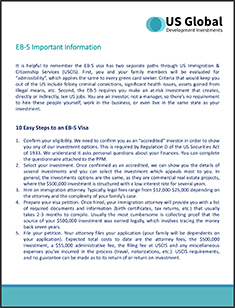
Choosing blindly for references might result in you working with mediocre or terrible immigration attorneys. Some might be handling too many cases at the same time, thus making them unable to dedicate enough time for each client. Some don’t have enough experience in certain areas of immigration law. Some are just trying to charge the heck of their clients.
- Get a referral from another professional
First of all, use another professional that is involved in immigration, like Registered Investment Advisor that is specializing only on immigration EB-5 investors. By law, this professional has fiduciary duties to Investor, meaning that they should advise in your best interest. The old fashion advice remains true: Word-of-mouth advertisement is powerful. - Ask for references
Once you get a referral (or two) to a good attorney, have initial consultation. During the consultation, a good attorney will suggest visa options you should consider. At the end, ask - Negotiate fixed fees ahead of time
Immigration attorneys just like any other attorneys, charge for their time. However, some attorneys have fixed set of fees for standard procedures, such as preparing and filing your case, and responding to requests for evidence. - The advantage of hiring a lawyer that speaks your language
For many EB-5 Investors the language can be the barrier. Finding a lawyer that .reads and speaks your language can help you to feel yourself comfortable.
Evaluation of the financial risk. We undertake due diligence evaluation of management, income and cash statement, profit & loss, and projections and much, much more for the project.
There are some very basic features of the project that you need to check at the very beginning:
- Check if all the jobs are created in the documents. Now the EB-5 industry accumulated enough experience, that the job creation should not be any problem. But some regional center’s project still do not do it right.
- See if Developer, who is responsible for building the project has sufficient experience and expertise.
Those are the basic requirement to the RC EB-5 Project. The risk of investment is the main factor determining the probability that you will get your money back.
The EB-5 visa is a way to get your green card and permanent residency through investment. The EB-5 investor visa program enables foreigners who make an investment in a U.S. business to obtain a green card and become lawful permanent residents, and eventual citizens, of the United States. The investment can lead to a green card for the investor to permanently live and work in the United States with their spouse and unmarried children under the age of 21. The EB-5 visa program is operated by United States Citizenship and Immigration Services (USCIS). The program was established by the United States Congress in 1990 to facilitate increased investment in the U.S. economy.
- EB-5 visa immigrant investment requirements
To meet EB-5 investor visa requirements, foreign investors must make an "at risk" capital investment in a for-profit U.S. business entity. The required investment amount is either $500,000 or $1 million, depending on which investment you invest in. If you invest in a targeted employment area (TEA) the investment is $500,000, if you invest elsewhere the minimum required investment is $1 million. EB-5 investments must lead to the creation of 10 fulltime U.S. jobs for at least two years. - How many EB-5 visas are issued each year?
USCIS reserves 10,000 visas for EB-5 investors each fiscal year. This 10,000 visa quota has never been met. There was a drastic increase in the number of EB-5 program participants in 2011, with more than 3,000 investors applying to the program. - Job creation requirements
According to USCIS, the EB-5 investment must preserve or create a minimum of 10 full-time positions for workers in the United States who qualify. This creation, or preservation, of jobs must occur within two years of the investor’s conditional permanent residency and entrance into the United States. Jobs created in EB-5 investments are defined as direct, indirect or induced. In the direct investment context, the EB-5 visa applicant must prove that the EB-5 capital resulted in the actualization of direct jobs of employees working directly in the business in which the investment was made. In the regional center context, the applicant can count direct, indirect, and induced jobs toward the job creation requirement
EB-5 visa applicants must follow three general steps to obtain U.S. permanent residency:
- Submit I-526 petition to USCIS demonstrating that you have made an EB-5 investment in an:
- Individual business that will create 10 direct fulltime U.S. jobs per investor (direct investment) OR
- In a USCIS-designated regional center where the investor may create 10 direct, indirect and/ or induced jobs per investor.
- Upon I-526 approval, the investor submits their conditional permanent resident application either through the filing of an I-485, Application for Adjustment of Status, or DS-230, Application for Immigrant Visa. This is the petition that will confer the green card to the investor and his eligible dependents.
- Lastly, the investors must prove that all EB-5 requirements have been met at the end of the two year conditional residency by filing the I-829 application to remove conditions of residency. The investor, their spouse, and their unmarried children under the age of 21 then become lawful permanent residents and receive their ten year green cards.
There are several types of business entities in which an EB-5 visa applicant can invest. In general, the applicants can invest directly in a new commercial enterprise or in a regional center. New commercial enterprises are lawful for-profit entities that can take one of many different business structures.
In addition to individual business enterprises, EB-5 visa applicants can also invest in EB-5 Regional Centers. Regional centers administer EB-5 investments. It may be more advantageous for an investor to invest in a regional center-run investment because the investor will not have to independently set up the EB-5 investments.
- $1 million capital investment, $500,000 in a TEA
- The investment must be made in a for-profit U.S. commercial entity
- The investment must create 10 full-time U.S. jobs for two years
How to obtain permanent residence (green card) through the EB-5 program
There are five general steps that investors must complete to become U.S. permanent residents through the EB-5 visa program. Once these steps have been completed, EB-5 investors, their spouse, and their unmarried children under the age of 21 become U.S. permanent residents. They will also have the option to become full U.S. citizens five years after obtaining their permanent residency.
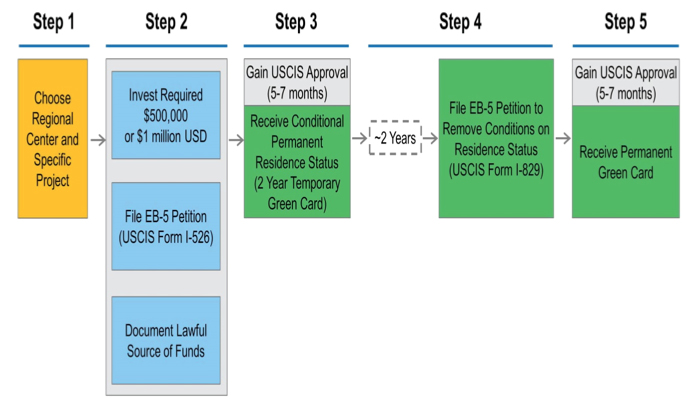
STEP 1: Locating an EB-5 Investment
The EB-5 applicant must first find a suitable business investment to invest in. EB-5 business investments generally take the form of either new commercial enterprises or regional center investments.
Investment Advisors often help EB-5 investors locate the investment that best suits their needs. Applicants must also ensure that they meet accredited investor income requirements in order to move forward with the EB-5 process.
STEP 2: Lawful source of capital
Funds used for the EB-5 investment must be earned lawfully. The investor must show the full source of the $500,000 or $1,000,000 investment and then trace those funds from the investor abroad into the new commercial enterprise. Common sources of funds are salary earnings, distributions from businesses or investments, sale of property, mortgage of personal assets owned by the investor, or gifts from third parties. If the investor receives a gift as the source of funds, the gift-giver must fully trace his or her funds that ultimately became the investment. Funds earned or obtained in the United States while the investor was out of status are not deemed to be lawfully acquired.
STEP 3: Capital Investment
After choosing an investment to invest in, the applicants must make the required capital investment amount in the investment that they have chosen. The investment must be $1 million, or $500,000 if the investment is situated in a Targeted Employment Area (TEA). These investments are often made into an escrow account. Then, an immigration attorney provides proof of this investment by filing an I-526 petition with USCIS. USCIS typically informs applicants whether or not their I-526 petition has been accepted after 12 to 18 months. In most situations the investor will be refunded invested money if your I-526 is denied.
STEP 4: Two Year Conditional permanent residency
The third step of the EB-5 application process is for the applicant to become a two year conditional resident of the United States so they can implement the investment funded by their EB-5 investment.
EB-5 investors are eligible to become U.S. residents once their I-526 petition has been approved by USCIS. Residency can be attained in one of two ways:
- If the EB-5 investor already has lawful status in the United States, then they must file form I-485 to adjust their status to conditional permanent resident
- If the investor does not already have lawful status in the United States, then they must file for an immigrant visa by submitting form DS-230 to the National Visa Center and they must process through the U.S. consulate or embassy in their home country.
Both of these steps typically require the help of an immigration attorney and the immigrant visa is issued, on average, in six to twelve months. During the two year conditional residency period, the investor is required to fulfill physical presence requirements, and cannot remain outside of the United States for more than one year without obtaining a re-entry permit.
STEP 5: Unconditional permanent residency and I-829 Petition
The final step in the EB-5 visa process is for applicants to become unconditional permanent residents by removing their two year conditional status. The I-829 petition is submitted to USCIS 90 days prior to the anniversary of the date that the applicant first received their conditional residency. This application proves that the investor has met all requirements of the EB-5 visa program: money is invested and 10 jobs are created.
USCIS most often issues a permanent green card six to eight months after the I-829 has been submitted. The investor, their spouse, and their unmarried children under the age of 21 can then permanently live and work in the United States and have the option to become U.S. citizens after a five year period from the date they received their initial conditional residency.
EB-5 Investment
<- The Investor may live anywhere in the United States, no matter where the investment is made.
- The EB-5 Visa does not require the applicant to manage the day-today affairs of a business.
- More than one person may invest in the same business.
- The residency benefit is extended to the Investor’s family (your spouse and unmarried children under 21 at the time of filing).
- The source of investment funds may come from any legal source; including gifts, loans, and divorce settlements.
- Indirect employment creation.
- No employee headaches.
- Investor can travel worldwide.
- Investor can work worldwide.
- Approval process is generally fast.
- No need to know the business.

Invest your money with real Professionals
Meet our Team of Specialists