
EB 5 Article
EB-5 Investment Impact
EB-5 and Tenant
How developers and landlords make use of the EB-5 programas part of their capital structure can be important for tenants to understand, particularly with regard to the benefits it imposeson its users.
- EB-5 capital is generally cheaper than standard forms of bank lending; the greater the fraction of borrowing financed by EB-5i nvestors, the lower a developer’s overall borrowing costs.
- EB-5f unds are often deposited into escrow and released to a developer conditional on the submission of the I-526 application
- Government delays in processing the different applications required by EB-5 investors during the visa approval process may limit a developer’s exit strategy
The Immigrant Investor Program also known as the EB-5 program was created by Congress in 1990 to stimulate economic growth through foreign investment. While certain EB (employment-based) visas are set aside for foreign workers based on their academic credentials or workplace skills, the EB-5 visa program affords foreign nationals and their spouses and unmarried children under age 21 the ability to obtain a U.S. visa based solely upon a minimum investment in a for profit enterprise that creates or retains a specified number of jobs.
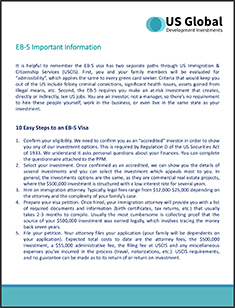
The EB-5 program is administered by the U.S. Citizenship and Immigration Services (USCIS), Non-U.S. residents can invest in a U.S. business ine xchange for permanent residency, provided that certain investment and job creation criteria are met.
All EB-5 investor must invest in a new commercial enterprise established after November 29, 1990, defined as any for-profit activity formed for the ongoing conduct of lawful business. Such enterprises may take the form of any legal entity, such as a joint venture, corporation or sole proprietorship, although non-commercial activities such as residence are expressly personal excluded. Note that foreign investment capital can beborrowed for purposes of the EB-5 program, “provided that the alien entrepreneur [immigrantinvestor] is personally and primarily liable and that the assets of the newc ommercial enterprise upon which the petition is based are not used to secure any of the indebtedness. “Invested” capital must also beat risk; the EB-5 investor cannot contribute capital in exchange for a guaranteed note or bond between himself/herself and the new commercial enterprise.
Each investment must create at least 10 full-time jobs within two years of the immigrant investor’s admission to the United States as a Conditional Permanent Resident. The investor, his/her spouse and/or children may not be counted as part of the 10 new full-time jobs. Evidence that proves that the EB-5 investor will be in a policy making or managerial role at the EB-5 project must also be provided.
Investors may opt to invest individually or as part of a larger investor pool via a Regional Center, an entity that has been designated by USCIS to attract immigrant investors in specific geographic areas in order to promote economic growth. While Regional Centers were originally designed to foster growth of exports, subsequent legislation expanded their mandate to also include “improved regional productivity, job creation or increased domestic capital investment.”
An investor who invests individually must show evidence that the investment will create 10 direct jobs i.e., jobs that result because the newly-created commercial enterprise directly employs those individuals. In contrast, the Regional Center Pilot Program, introduced in 1993, allows for applicants to pool their investments in to a larger project assembled by a RegionalCenter, for which indirect jobs may be counted. Indirect jobs are jobs that support the newly created enterprise—for example, the producers of materials that the newly-formed commercial enterprise uses and are “created collaterally or as a result of capital invested in a commercial enterprise affiliated with a regional center by an EB-5 investor. ”Indirect job counts may only be used in job creation estimates if an investor affiliates with a regional center. The specific required investment amount under the EB-5 program depends on whether or not the investment is made in an economically depressed location that qualifiesas a targeted employment area (TEA). In order to qualify for the TEA designation, at the time of investment, the area or experiencing unemployment of at least 150 percent of the national average rate. The minim umqualifying investment either within a high unemployment area or rural area in the United States is $500,000; otherwisea $1 million investment is needed to satisfy the capital investment requirement.
A glossary of additional terms related to the EB-5 program appears in Appendix I. Note that subject to the total and per country limits for the program, there are no per state or per project visa limits.
More than 95% of all EB-5 investments now come via Regional Center applications, largely because an investor in a Regional Center is free of the day-to-day active management of a business. An investor in a Regional Center is able to reside anywhere in the U.S.; the “managerial role” requirement in the investment is fulfilled by having voting rights in a project structured as either a limited partnership or limited liability company. In contrast, an individual investor would likely need to reside near the newly created commercial enterprise he/she is managing. In a Regional Center project, evidence of indirect job creation is accomplished through economic models; recall that the new enterprise it self does not necessarily need to create the requisite number of jobs directly on its own. Evidence of the direct jobs an individual investor must create usually requires copies of new workers ’W-2 and I-9 statements a much more rigorous standard and a challenge to make sure that the new enterprise supports the jobs over the minimum two-year time period. The downside of a Regional Center investment is that most opportunities are not designed to offer a competitive rate of return to investors; those seeking to run a business and maximize profits are usually better served by investing individually.
Application Name |
Application Title |
Purpose |
Average Processing Time |
|---|---|---|---|
I-526 |
Immigrant Petition By Alien Enterpreneur |
For use by an enterpreneur who wishes to immigrate to the United States. |
14.7 months |
I-829 |
Petition by Entrepreneur to Remove Conditions |
Removal of lawful permanent resident conditions for immigrant investors. |
8.6 months |
I-924 |
Application for Regional Center Under the Immigrant investor Pilot Program |
To extablish a Regional Center in order to legally accept investments. |
9.0 months |
- Identify and invest in a new commercial enterprise that will create the required number of jobs, either on a stand-alone basis or via a rigional center.
- Individuals and regional center investors submit an I-526 petition that verifies a) that the invested funds have been obtained legally and b) that the immigrant investor has invested, or is in the process of investing, the required amount of capital in a new commercial enterprise in the United States that will create full-time positions for not fewer than ten qualifying employees. Evidence that proves that the EB-5 investor will be in a policy-making or managerial role at the EB-5 project must also be provided. Approval (or “adjudication”) of the I-526 petition currently takes about 15 months.
- After the I-526 is approved:
- If the investor is already legally in the U.S., he/she applies for Adjustment of Status to Conditional Residence via Form I-485 and awaits approval through USCIS, provided that visas are available.
The investor, investor’s spouse and any dependents must each file this form (this is typically done by an immigration attorney). This step can take about 4 months. - If the investor is not residing legally in the U.S. he/she files electronic form DS-260 and awaits an interview with a home country U.S. Embassy or Consulate a process overseen by the State Department. The National Visa Center (NVC) states that applicants should allow 60 days for the NVC to review your forms and documents,” and also advises that “there may be a wait of several months for an interview date to become available.” Note that upon approval of the immigrant visa, the investor has a full 6 months to enter the United States and becomes a conditional resident upon entry.
After the above step, an investor receives Conditional Permanent Resident Alien Status Approval (I-551)— a Green Card with a twoyear expiry.
- If the investor is already legally in the U.S., he/she applies for Adjustment of Status to Conditional Residence via Form I-485 and awaits approval through USCIS, provided that visas are available.
- 90 days prior to the twoyear anniversary of the conditional Green Card, an investor files a Petition to Remove Conditions on Residence (I-829), as the conditional Green Card (granted in the step above) cannot be renewed. The applicant’s conditional residency will be extended while the I-829 is being processed, and an applicant remains in valid status during this period. The I-829 petition must be accompanied by information showing that the applicant has fulfilled all requirements of the EB-5 program, including evidence that the minimum investment has been made and continuously maintained, that the investor has been “active” in the business management process, and that the required jobs have been created. If the I-829 application is approved, the investor, his/her spouse and any unmarried children under the age of 21 receive a ten-year green card, renewable indefinitely, which confers permanent resident status. I-829 adjudication currently takes about 8-9 months. A full list of the relevant filing document appears on Table 1 on the previous page.
Table 02. EB-5 Visa Issuance
Fiscal Year Total |
Portion from TEA Regional Centers |
All Other |
Total EB-5 Issuance |
|---|---|---|---|
2008 |
1,055 |
388 |
1,443 |
2009 |
3,519 |
699 |
4,218 |
2010 |
1,312 |
564 |
1,885 |
2011 |
3,076 |
387 |
3,463 |
2012 |
7,312 |
329 |
7,641 |
2013 |
8,087 |
477 |
8,564 |
2014 |
10,375 |
317 |
10,692 |
Table 3. I-526 Petitions by Entrepreneur, by Fiscal Year and Status
Fiscal Year Total |
Petitions Received |
Petitions Approved |
Petitions Denied/ Withdrawn |
Petitions Pending |
|---|---|---|---|---|
2008 |
1,258 |
642 |
120 |
853 |
2009 |
1,031 |
1,265 |
208 |
514 |
2010 |
1,953 |
1,369 |
165 |
1,125 |
2011 |
||||
2012 |
6,041 |
3,677 |
957 |
5,018 |
2013 |
6,346 |
3,699 |
943 |
7,131 |
2014 |
10,923 |
4,925 |
1,169 |
12,453 |
Oct-Dec 2014 (Q1 FY2015) |
2,941 |
1,652 |
133 |
13,526 |
Table 4. EB-5 Estimated Numerical Limits
(Assumes All Countries Use Maximum Visa Allotment)Fiscal Year Total |
China |
All Other Individual Countries |
Worldwide Cap Total |
|---|---|---|---|
2014 |
45* |
745 |
10,650 |
2015 |
15* |
715 |
10,224 |
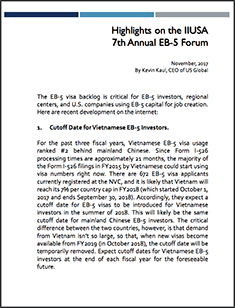
Every U.S. fiscal year (which runs from Oct 1st of the prior calendar year to September 30th of the current calendar year), 140,000 employmentbased immigrant visas are made available. The EB-5 program, which is one of five employment based preference programs, limits the total number of investor visas to 7.1 percent of the employment-based total for any fiscal year, or 9,940. Of this amount, 3,000 visas per fiscal year are set aside for qualifying immigrants who invest in a TEA-designated locale, while an additional 3,000 visas per year are set aside for investors in a Regional Center project. Note that there is a second layer of restrictions on the total number of employment-based visa allocated limits by country. The total number of immigrant visas to natives of any foreign state made available under the familysponsored immigrant visa program and the employmentbased immigrant visa program in any fiscal year may not exceed 7%. Employmentbased immigrant visas are issued in the chronological order in which the petitions are filed up until the annual numerical limit for the fiscal year per category is reached. The filing date of an I-526 petition becomes the applicant's priority date; visas cannot be issued until an applicant's priority date has been reached. Up until earlier this year, the overall EB-5 visa quota had never been met either in aggregate or on a per country basis. In late August 2014, however, the head of the Department of State Immigrant Visa Control and The first step of the EB-5 process is the completion of the I-526 application, which is filed only by the foreign investor to USCIS with the required evidence of investment and job creation, among other things, alongside a $1,500 filing fee. There is no limit on the number of I-526 filings that may be made in any year, and importantly, there are no limits on the number of I-526 approvals in any year. As USCIS states in the I-526 instructions, “if you have established that you qualify for investor status, the petition will be approved… approval…does not guarantee the U.S. Embassy or U.S. Consulate will issue the immigrant visa.” The list of pending I-526 petitions is quite extensive: At the end of December 2014, there were over 13,000 petitions pending, even after a record-setting4,125 approvals in the last fiscal year (Table 3), further indication of the program’s robust demand. Following I- 526 is approval by USCIS, each investor (along with his/ her spouse and his/her unmarried children under the age of 21) is eligible to apply for a Green Card, either via an adjustment of status through form I-485 (for those in the U.S.) or through an immigrant visa at a U.S. consul or embassy (for those living abroad.) As a result, the 13,526 I-526 petitions pending likely imply at least two times the number of visas desired, assuming that eachapplicant brings, at minimum, a spouse or child.
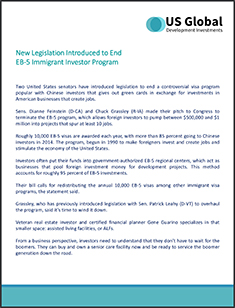
Looking ahead, it’s likely that the maximum number of allowable visas under the 2015 EB-5 program will be reached in Q2 2015. Given fears over a slowdown in China (and in particular, in China’s property market) it is likely that foreign appetite for U.S. investment will remain strong. We expect the list of EB-5 projects to continue to grow, particularly given demographic changes in the U.S. (Healthcare projects, such as hospices, long-term care facilities, medical centers and public housing or seniors could all see increased EB-5 investment.) Both potential investors and tenants should be aware that the Regional Center program (which comprises the majority of EB-5 investment) is set to expire at the end of September. Although the program has already been extended and renewed several times (most recently from September 2012 September 2015), the program’s continuity may be a bit more of a wildcard in the current political cycle given discussion of broader immigration reform. It’s possible that opponents of the EB-5 program will be more vocal; Senate Judiciary Committee Chair Chuck Grassley, has criticized the program on the basis that visas may be going to people of “questionable background” from a national security and safety perspective. Other adjustments may also come under consideration, ranging from the number of visa approvals (note that the approximately 10,000 EB-5 visas per year includes the spouses and children of investors) to the definition of a “Targeted Employment Area” and the associated reduction in invested capital such a project requires versus projects located elsewhere.
If an increase in EB-5 visa applications causes priority dates to retrogress, the impact for participants could be substantial. Based on the reading of USCIS’ May 2013 policy memorandum, developers should be aware of investment horizons longer than initially anticipated.
“If, two years after obtaining conditional permanent resident status, the immigrant investor has sustained the investment, created or can be expected to create within a reasonable period of time ten full-time jobs to qualifying employees, and is otherwise conforming to the EB-5 Program’s requirements, the conditions generally will be removed and the immigrant investor will be an unconditional lawful permanent resident… the regulations require the submission of documentary evidence that establishes that it is more likely than not that the investor is in ‘substantial’ compliance with the capital requirements and that the jobs will be created ‘within a reasonable time.’ The ‘within a reasonable time’ requirement permits a degree of flexibility to account for the realities and unpredictability of starting a business venture, but it is not an open-ended allowance. The regulations require that the business plan submitted with Form I-526 establish a likelihood of job creation “within the next two years,” 8 C.F.R. § 204.6(j) (4)(i)(B), demonstrating an expectation that EB-5 projects will generally create jobs within such a timeframe. Whether a lengthier timeframe for job creation presented in a Form I-829 is ‘reasonable’ is to be decided based on the totality of the circumstances presented, and USCIS has latitude under the law to request additional evidence concerning those circumstances. Because the law contemplates two years as the baseline expected period in which job creation will take place, jobs that will be created within a year of the two-year anniversary of the alien’s admission as a conditional permanent resident or adjustment to conditional permanent resident may generally be considered to be created within a reasonable period of time. Jobs projected to be created beyond that time horizon usually will not be considered to be created within a reasonable time, unless extreme circumstances, such as force majeure, are presented.”
The “new commercial enterprise” that is the basis of the EB-5 applicant’s investment may not necessarily be the jobcreating entity responsible for ten new full-time jobs. Projects may be structured so that foreign nationals invest in a limited partnership or LLC that provides a loan or takes an equity stake in a qualifying real estate development. As a result, it is the development, not the LLC, that is the job-creating entity. (In this case, the LLC would be the “new commercial enterprise”.) If the limited partnership agreement or operating agreement between the new commercial enterprise and immigrant investor provides that the investor may demand return of or redeem some portion of capital after obtaining conditional lawful permanent resident status (i.e., following approval of the investor’s Form I-526 and subsequent visa issuance or approval of the investor’s adjustment of status via Form I-485), that portion of capital is not at risk and conditions for a Permanent Green Card will not have been met. As a result, a developer may be “stuck” holding on to applicants’ investment funds should there be delays in the visa process—including, but not limited to, retrogression. Such a delay can impede a developer’s opportunity to recapitalize and/or exit a projectduring the process.
Capital Investment means cash, equipment, inventory, other tangible property, cash equivalents and indebtedness secured by assets owned by the alien entrepreneur, provided that the alien entrepreneur is personally and primarily liable and that the assets of the new commercial enterprise upon which the petition is based are not used to secure any of the indebtedness. All capital is valued at fair-market value in United States dollars. Assets acquired, directly or indirectly, by unlawful means (such as criminal activities) are not considered capital. Capital is considered “invested” when the EB-5 investor’s capital is actually transferred into the new commercial enterprise. Funds held in escrow are not counted as capital invested for the purposes of completing Form I-924.
Chargeability refers to the independent country to which an immigrant entering under the preference system is accredited. No more than 7 percent of the family-sponsored and employment-based visas may be issued to natives of any one independent country in a fiscal year. No one dependency of any independent country may receive more than 2 percent of the family-sponsored and employmentbased visas issued. These limits are based on visa issuance rather than visa entries into the U.S. Chargeability is usually determined by country of birth. Exceptions are made to prevent the separation of family members when the limitation for the country of birth has beenmet.
Full-Time Employment means employment of a qualifying employee by the new commercial enterprise in a position that requires a minimum of 35 working hours per week employing a U.S. citizen, permanent resident or other authorized immigrant worker. In the case of the Immigrant Investor Pilot Program, "full-time employment" also means employment of a qualifying employee in a position that has been created indirectly from investments associated with the Pilot Program.
A Job-Sharing Arrangement whereby two or more qualifying employees share a full-time position will count as full-time employment provided the hourly requirement per week is met. This definition does not include combinations of part- time positions or full-time equivalents even if, when combined, the positions meet the hourly requirement per week. The position must be permanent, full-time and constant. The two qualified employees sharing the job must be permanent and share the associated benefits normally related to any permanent, full-time position, including payment of both workman’s compensation and unemployment premiums for the position by the employer.
A Qualified Employee is a U.S. citizen, permanent resident or other immigrant authorized to work in the United States. The individual may be a conditional resident, an asylee, a refugee, or a person residing in the United States under suspension of deportation. This definition does not include the immigrant investor; his or her spouse, sons, or daughters; or any foreign national in any nonimmigrant status (such as an H-1B visa holder) or who is not authorized to work in the United States.
A Troubled Business is an enterprise that has been in existence for at least two years and has incurred a net loss during the 12- or 24-month period prior to the priority date on the immigrant investor’s Form I-526. The loss for this period must be at least 20 percent of the troubled business’ net worth prior to the loss. For purposes of determining whether the troubled business has been in existence for two years, successors in interest to the troubled business will be deemed to have been in existence for the same period of time as the business they succeeded.
EB-5 Investment
<- The Investor may live anywhere in the United States, no matter where the investment is made.
- The EB-5 Visa does not require the applicant to manage the day-today affairs of a business.
- More than one person may invest in the same business.
- The residency benefit is extended to the Investor’s family (your spouse and unmarried children under 21 at the time of filing).
- The source of investment funds may come from any legal source; including gifts, loans, and divorce settlements.
- Indirect employment creation.
- No employee headaches.
- Investor can travel worldwide.
- Investor can work worldwide.
- Approval process is generally fast.
- No need to know the business.

Invest your money with real Professionals
Meet our Team of Specialists