
EB 5 Article
EB-5 News
Some dates to keep in mind as we wonder what will happen next with EB-5:
- January 19, 2018: The next regional center program sunset date (and the deadline for a new funding bill that some hoped to make a vehicle for sweeping new immigration legislation). It’s looking likely that this deadline will be pushed back a few weeks, however, with another continuing resolution.
- February 2018: The date indicated for final action on new EB-5 regulations (with provisions including drastic increase to the EB-5 investment amount)
- February 16, 2018: Possible next regional center program sunset date, if Congress fails to pass a new funding bill in January, and instead defers the funding and immigration fight with a continuing resolution (or some speculate the CR could go into March)
- March 5, 2018: The date DACA protections are slated to end, and thus the date Congress is pushing to beat in passing a big immigration bill
- April 2018: The possible effective date for new EB-5 regulations, assuming that the rule is finalized in February with an effective date after 60 days (as ILW rumors)
The race is on for EB-5 legislation, with pressure from sunset dates and the need to forestall unwelcome regulations. Washington is actually talking about comprehensive immigration reform, including reshuffling visa numbers. But EB-5 haven’t been mentioned once, for good or ill, anywhere, by anyone, in recent immigration discussion.
EB-5 topic needs action from the Congress: to give the regional center program a longer-term authorization, to enact program changes better than what would come with new regulations, and to realize program potential by freeing up more visas for EB-5.
If broad-based immigration legislation happens soon, what will it include and how will it affect EB-5?
On January 09, President Trump hosted a bipartisan and bicameral meeting on immigration reform that concluded (reportedly) with “an agreement to negotiate legislation that accomplishes critically needed reforms in four high-priority areas: border security, chain migration, the visa lottery, and the Deferred Action for Childhood Arrivals policy”.
In the same week, House Judiciary Chairman Bob Goodlatte introduced H.R. 4760 Securing America’s Future Act, which proposes sweeping changes in line with President Trump’s immigration priorities. The bill includes nothing that would directly affect EB-5. Meanwhile, the Senate is still trying to come up with a competitive immigration deal that’s more passable by Congress while still signable by the President.
While we have our eye on the legislation ball, the Office of Management and Budget has given a new EB-5 deadline to think about. The Spring 2017 Unified Agenda had mentioned April, 2018 as a “Final Action Date” for regulations dealing with EB-5 investment amounts and TEAs (RIN 1615-AC07), but now the Fall 2017 agenda has advanced that prediction to February, 2018. Advancing the date to February looks like positive intent to really get the EB-5 regulations done.
As a reminder, here’s what the new regulations proposed:
- Increase the standard minimum EB-5 investment amount to $1,800,000, or $1,350,000 in a TEA.
- A TEA is based on high unemployment and incentivized with 25% reduction to the investment amount (not other factors or incentives as proposed by Congress).
- A TEA can only be designated for a high-unemployment MSA, county, city, single census tract, or limited group of census tracts. DHS, not the states, is responsible for TEA designation.
- Give priority date protection (an investor with an approved I-526 could choose to file a new I-526 while keeping the original priority date, subject to certain restrictions)
- Spouse and children may be able to file I-829 even if not included on the principal investor’s petition.
- Other technical changes.
The federal rulemaking process requires that “At the end of the process, the agency must base its reasoning and conclusions on the rulemaking record, consisting of the comments, scientific data, expert opinions, and facts accumulated during the pre‐rule and proposed rule stages.” If USCIS revised the proposed rule in response to public comment, they might have modified the proposed investment amount increases, either narrowed or expanded the gap between TEA and non-TEA investment, modified the restrictions on census tract TEAs, or reconsidered giving DHS the burden of issuing TEA designations.
On the other hand, USCIS is not well known for changing track in response to evidence and arguments presented by the public. The USCIS thinking about the potential costs and benefits of the proposed regulations is:
The proposal to raise the investment amounts and reform the targeted employment area (TEA) geography could deter some investors from participating in the EB-5 program. The increase in investment could reduce the number of investors as they may be unable or unwilling to invest at the higher proposed levels of investment. On the other hand, raising the investment amounts increases the amount invested by each investor and thereby potentially increases the total economic benefits of U.S. investment under this program. The proposed TEA provision would rule out TEA configurations that rely on a large number of census tracts indirectly linked to the actual project tract by numerous degrees of separation, and may better target investment capital to areas where unemployment rates are the highest.
If a final rule were published in the Federal Register in February 2018, it could go into effect as early as March 2018, and apply to petitions filed on or after the effective date. On the other hand, the threat of immanent regulations may inspire Congress/industry to finalize EB-5 legislation ASAP instead.
DHS is still in the process of reviewing potential changes it would propose to the regional center process. DHS may propose to implement an exemplar filing requirement for all designated regional centers that would require regional centers to file exemplar project requests. An exemplar filing requirement could cause some projects to not go forward, but DHS is still in the process of assessing the impacts on the number of projects that may be affected. DHS anticipates that any proposed changes to the regional center program would increase overall program efficiency and predictability for both USCIS and EB-5 stakeholders.

EB-5 Investment
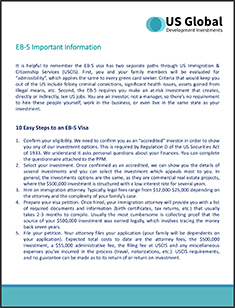
<- The Investor may live anywhere in the United States, no matter where the investment is made.
- The EB-5 Visa does not require the applicant to manage the day-today affairs of a business.
- More than one person may invest in the same business.
- The residency benefit is extended to the Investor’s family (your spouse and unmarried children under 21 at the time of filing).
- The source of investment funds may come from any legal source; including gifts, loans, and divorce settlements.
- Indirect employment creation.
- No employee headaches.
- Investor can travel worldwide.
- Investor can work worldwide.
- Approval process is generally fast.
- No need to know the business.

Invest your money with real Professionals
Meet our Team of Specialists